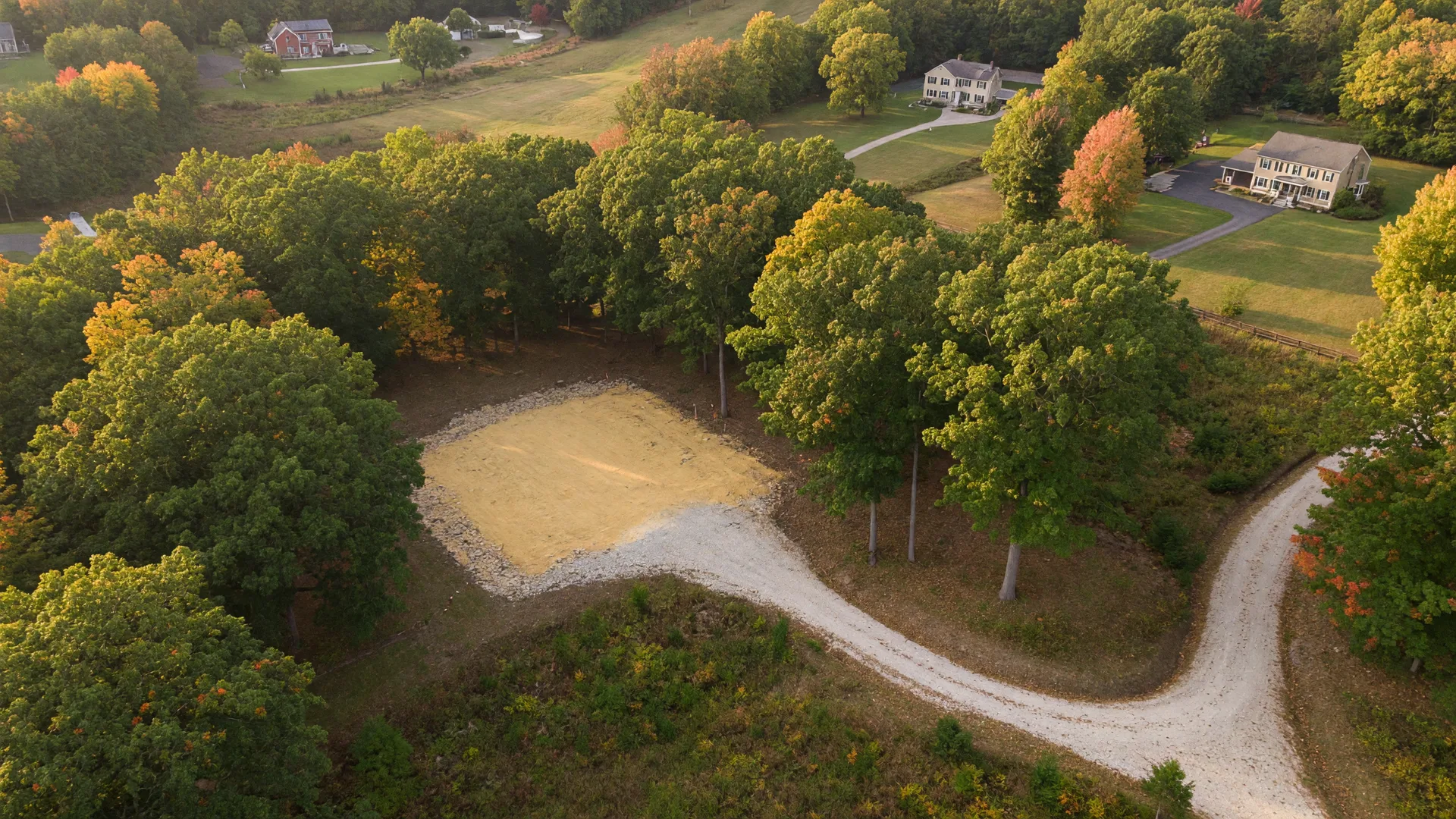
Buying a wooded one-acre lot in Southeast Michigan and building a custom home on it sounds idyllic — and in most ways, it is. Rolling terrain, mature trees, real privacy, and a homesite that feels like it's always been part of the landscape. But for buyers who've only lived in established subdivisions, the process of actually building on raw wooded land raises a set of practical questions that don't come up when you buy a move-in-ready resale. What about the septic system? Do you need a perc test? What happens to the trees? How do utilities get to the lot?
These are the right questions to ask — and they're exactly the ones that separate a smooth custom-building experience from an expensive surprise. Whether you're considering a homesite at Oaks of Tyrone in Tyrone Township or evaluating raw land elsewhere in Livingston County, here's what you need to know about site preparation, septic systems, and tree preservation before you break ground.
Why wooded lots are drawing buyers to Southeast Michigan
Across Fenton, Tyrone Township, Grand Blanc, and the broader Livingston and Genesee County area, demand for wooded one-acre homesites has been climbing steadily. The reason is straightforward: buyers want space, privacy, and a connection to the land that standard subdivisions can't deliver. A full acre surrounded by mature oaks, maples, and pines is a fundamentally different setting than a quarter-acre lot in a production-built neighborhood where the trees are two years old and the neighbors are close enough to hear through the walls.
The tradeoff is that building on wooded acreage involves more planning than building on a cleared subdivision pad. The land needs to be evaluated, the infrastructure needs to be planned, and the trees — which are the whole point — need to be handled with care. Understanding the process upfront makes all the difference.
Site preparation — what it takes to build on wooded land
Site preparation is the first phase of any custom build, and it matters more on wooded acreage than on a cleared lot. Before construction begins, the builder needs to evaluate soil conditions, drainage patterns, access to the building pad, and the specific characteristics of the land. On wooded lots, this evaluation is more detailed because the terrain is rarely flat, the soil composition can vary across the property, and the tree root systems affect where and how you can dig.
Key elements of site preparation for a wooded one-acre lot include:
- Soil evaluation and perc testing — required for septic system approval (more on this below)
- Topographic survey — maps the elevation changes, drainage paths, and optimal building pad location
- Tree inventory and preservation plan — identifies which trees stay and which need to be removed for the building envelope
- Grading and drainage design — ensures water flows away from the home and doesn't cause erosion or ponding
- Utility routing — plans how water, sewer (or septic), electric, gas, and internet reach the home
- Access and driveway design — determines the best path from the road to the garage, accounting for grade and trees
The quality of this upfront work determines the quality of everything that follows. A builder who shortcuts the site evaluation phase is more likely to run into costly surprises during construction — drainage problems, unexpected soil conditions, or tree damage that could have been avoided.
Septic systems and perc testing in Michigan — the basics
In most of rural and suburban Michigan — including Tyrone Township, Fenton, and much of Livingston County — homes are served by private septic systems rather than municipal sewer. This is one of the most important things for buyers to understand when evaluating wooded land for a custom build, because the septic system determines where the home can sit on the lot, how large the home can be, and what the long-term maintenance obligations look like.
What is a perc test?
A perc (percolation) test measures how quickly water drains through the soil on a specific homesite. The county health department requires a perc test before approving a septic system permit, because the soil's ability to absorb and filter wastewater determines what type of septic system can be installed. The test involves digging bore holes at the proposed drain field location, saturating them with water, and measuring how fast the water level drops. If the soil drains too slowly, a standard gravity-fed system won't work and an engineered or alternative system may be required — which adds cost.
How long does the septic permit process take?
In Genesee and Livingston counties, the septic permit process typically takes two to six weeks, depending on the county's current backlog and whether the soil evaluation reveals any complications. Buyers should factor this timeline into the construction schedule — the septic permit needs to be in hand before excavation begins, and in some cases, the soil evaluation needs to happen during a specific season when ground conditions are suitable.
What does a septic system cost?
A standard gravity-fed septic system in Southeast Michigan typically costs between $8,000 and $15,000, depending on soil conditions, lot size, and the number of bedrooms in the home. Engineered systems, required when soil conditions do not suit a gravity system, can cost $20,000 to $40,000 or more. The wide range is why the perc test matters so much: it tells you early in the process what type of system the soil will support, so there are no surprises after you've committed to a homesite.
Community septic systems — how developments like Oaks of Tyrone handle it
One of the advantages of buying into a planned community like Oaks of Tyrone is that the septic infrastructure is handled at the community level rather than lot by lot. Oaks of Tyrone uses a community septic system with pre-treatment, which means the developer has already completed the soil evaluation, engineering, and permitting for the entire community before individual homesites are sold.
For buyers, this matters in three practical ways:
- No individual perc test required — the community system has already been approved, so each homesite can move directly to the building phase without waiting for a lot-specific soil evaluation
- Lower cost — a community system is typically more cost-effective than an individual system, and the cost is factored into the home package price rather than added as a separate line item
- Predictable timeline — with the septic infrastructure in place, there's no risk of a failed perc test delaying construction after you've purchased a homesite
This is one of the less-visible advantages of buying into a community like Oaks of Tyrone versus purchasing raw land independently. The infrastructure planning — septic, utilities, roads, drainage — has already been done by an experienced developer, and the risk of soil-related surprises has been engineered out of the process.
Tree preservation — why it matters and how builders handle it
For most buyers looking at wooded acreage, the trees are the primary attraction. Mature hardwoods — oaks, maples, hickories — provide privacy, shade, seasonal beauty, and a sense of permanence that no amount of landscaping can replicate. But building a home on a wooded lot requires removing some trees for the building pad, driveway, and utility access. The question is how much gets removed and who decides.
There's a significant difference between a builder who clears the entire lot and one who preserves the maximum number of mature trees while positioning the home for the best possible setting. The approach matters not just for aesthetics, but for property value, energy efficiency (shade from mature trees can reduce cooling costs by 15–35%), and the long-term character of the community.
Big Sky Development's approach at communities like Oaks of Tyrone centers on intentional tree preservation. Rather than clear-cutting and replanting, Big Sky designs the community layout and individual homesites to preserve as many mature trees as possible. The building envelope is positioned to work with the existing tree canopy, not against it. The result is a neighborhood that feels established from day one — not a construction zone that needs 20 years of tree growth to recover.
Utilities on rural homesites — what to expect
Beyond septic, buyers evaluating wooded one-acre lots need to understand how utilities reach the homesite. In most of the Tyrone Township and Fenton area:
- Electric — typically available from the road via DTE Energy or the local utility provider. Extension costs depend on the distance from the nearest transformer to the building pad.
- Natural gas — available in many areas from Consumers Energy, though not universally. Some wooded lots may require propane instead.
- Water — most rural lots in the area use private wells. A well installation typically costs $5,000 to $15,000 depending on depth and yield. Some communities, including Oaks of Tyrone, have community water systems that eliminate the need for individual wells.
- Internet — high-speed internet availability varies by area. Buyers should verify availability from providers like Xfinity, AT&T, or local fiber providers before purchasing a homesite.
In planned communities, much of this infrastructure is pre-installed or pre-planned, which reduces individual lot costs and eliminates the uncertainty that comes with buying raw land. At Oaks of Tyrone, utilities are routed and available at the lot line, so buyers aren't navigating utility coordination on their own.
The real advantage: planned communities vs. raw land
For buyers who want the wooded-one-acre experience without the headaches of raw land development, a planned community like Oaks of Tyrone offers a clear advantage. The developer — in this case, Big Sky Development — has already handled the hardest parts: soil evaluation, septic engineering, utility routing, road construction, drainage planning, and tree preservation. The buyer's job is to choose a homesite, design a floor plan, and select finishes.
Compare that to buying raw land and managing the development process independently — which typically involves hiring a surveyor, environmental engineer, septic designer, civil engineer, and utility contractors, with each step carrying its own timeline, cost, and risk. For most buyers, the community approach is faster, more predictable, and less expensive overall, even if the raw land itself looks like a lower upfront cost.
At Oaks of Tyrone, custom home packages start from $629,900. That price covers a standard lot, the community infrastructure, a fully custom floor plan, and a 10-year in-house structural warranty from Big Sky Development. The simplicity of the process — one builder, one price, one team from design through move-in — is part of what makes the community model work for buyers who want the custom experience without the raw-land complexity.
Frequently asked questions
Do I need a perc test to build on a wooded lot in Michigan?
If the lot will use a private septic system, yes — a perc test is required by the county health department before a septic permit can be issued. However, in planned communities like Oaks of Tyrone, the septic system is engineered at the community level, so individual lot perc tests are not required.
How much does a septic system cost in Southeast Michigan?
A standard gravity-fed septic system typically costs $8,000 to $15,000. Engineered systems for difficult soil conditions can cost $20,000 to $40,000 or more. In community systems like those at Oaks of Tyrone, the cost is included in the overall build.
What trees get removed when building on a wooded lot?
The builder removes trees within the building envelope — the footprint of the home, driveway, and immediate utility access area. At communities like Oaks of Tyrone, Big Sky Development designs the homesite layout to preserve the maximum number of mature trees, keeping the surrounding wooded privacy intact.
Is it cheaper to buy raw land or build in a planned community?
Raw land has a lower sticker price, but the total cost of development — surveying, perc testing, septic installation, well drilling, utility extension, road access, and permitting — often brings the final cost close to or above the community model. Planned communities like Oaks of Tyrone include all infrastructure in the home package price, with no separate development costs.
How long does it take to build a custom home on a wooded lot?
From permit approval to move-in, most custom homes in the Fenton and Tyrone Township area take 8 to 14 months to build, depending on size, complexity, and weather. In planned communities where infrastructure is already in place, the construction timeline often runs on the shorter end of that range.
Does building on a wooded lot cost more than a cleared lot?
Site preparation on wooded acreage can cost more than on a cleared subdivision lot due to tree preservation planning, grading on uneven terrain, and longer utility runs. However, the long-term value of mature trees — shade, privacy, aesthetics, and energy savings — typically outweighs the additional upfront site cost.
Have questions about building on wooded acreage?
Rob Moen can walk you through everything — from site preparation and septic to floor plans and financing. Contact him directly to schedule a tour of available homesites at Oaks of Tyrone, or ask anything about the process of building a custom home in Tyrone Township.