If you're shopping for new construction in Southeast Michigan, you've probably noticed that not all "new homes" are the same. Some builders offer a handful of pre-designed floor plans with a short list of upgrade options. Others let you start from scratch — designing a home around your land, your lifestyle, and your priorities. Both approaches have their place, but they serve very different buyer profiles.
The question isn't which one is "better" in the abstract. It's which one is right for you — your budget, your timeline, your tolerance for decision-making, and your vision of what home should feel like. For buyers considering communities like Oaks of Tyrone in Tyrone Township, understanding the difference between production builders and true custom builders is the first step in making an informed choice.
What is a production builder?
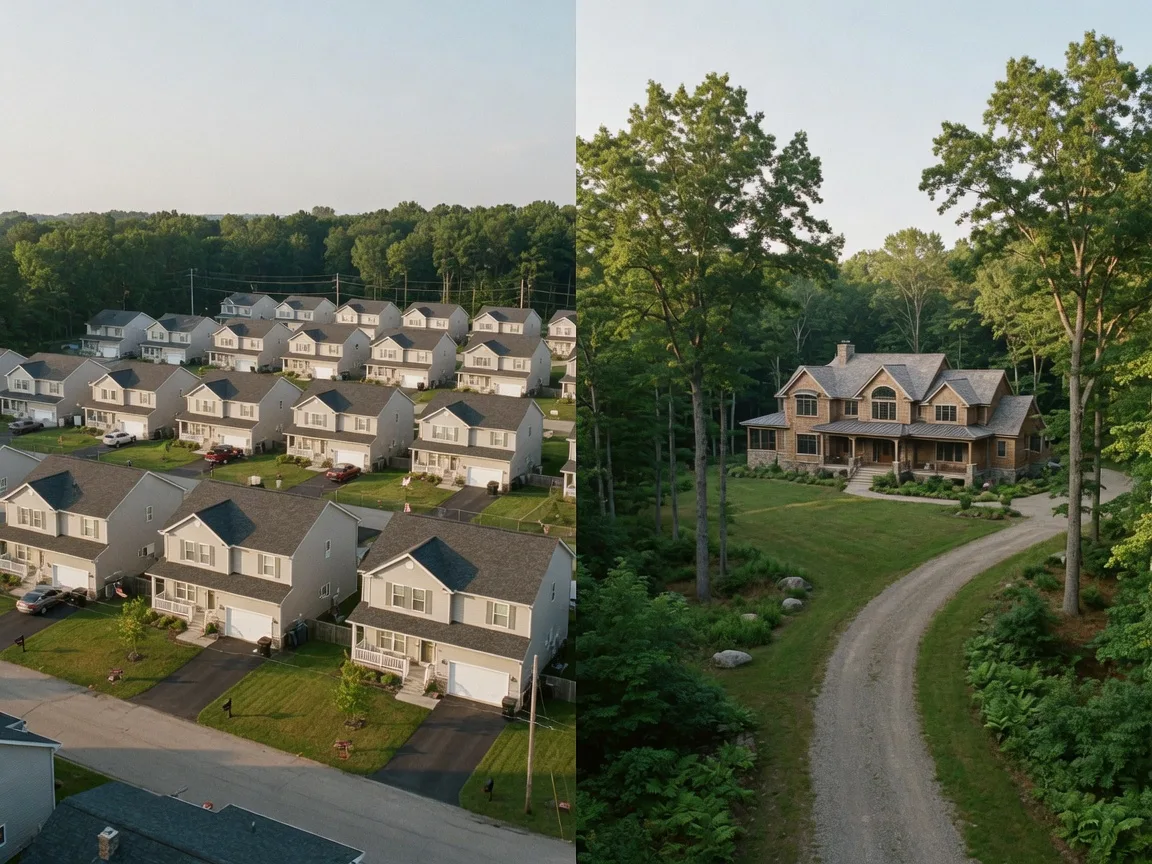
Production builders — sometimes called tract builders — build homes from a set of pre-designed floor plans, typically in planned subdivisions where every lot receives one of a handful of home models. The buyer picks from a menu of options: which elevation style, which countertop material, which cabinet finish. The homes are built on a fixed schedule, often several at a time, using standardized materials and subcontractor crews that rotate from house to house.
The advantages are real. Production builders offer predictability — fixed prices, established timelines, and a showroom where you can see your exact finishes before you commit. They're generally faster than custom builders, and their volume purchasing power can keep per-square-foot costs lower. For buyers who value speed and simplicity over personalization, a production builder can be a great fit.
The tradeoff is flexibility. With a production builder, you're choosing from options, not creating from scratch. Want to move a wall, add a window where the plan doesn't have one, or change the room layout? In most cases, the answer is no — or yes, at a premium that makes you wonder why you paid extra. The lot sizes in production subdivisions tend to be smaller too — quarter-acre or less — because the model is built around density, not acreage.
What is a custom home builder?
A true custom home builder doesn't start with a pre-designed floor plan. They start with your homesite — its topography, its tree canopy, its orientation to the sun — and design a home that fits the land and your life. You're not picking from options on a list. You're making real decisions about layout, room sizes, ceiling heights, window placement, material selections, and every detail that makes a home yours.
The custom approach takes longer and costs more per square foot. But it delivers something a production builder can't: a home designed around you. Every decision, from the width of the hallways to the depth of the kitchen island, is made intentionally rather than accepted as part of a standard package. And on a wooded one-acre lot, the custom approach means the home can be positioned to preserve mature trees, capture natural light, and take advantage of views — rather than forcing a standard plan into a site it wasn't designed for.
At Oaks of Tyrone, Big Sky Development operates as a true custom builder. Buyers work directly with Big Sky's in-house design team in their own showroom, selecting finishes and tailoring floor plans from 26 available home designs — or creating something entirely unique. The homes are built on full wooded one-acre lots with intentional tree preservation, not on cleared subdivision pads. The builder's owner personally visits active jobsites to oversee quality on every home under construction.
Key differences at a glance
| Factor | Production Builder | Custom Builder (Big Sky Development) |
|---|---|---|
| Floor plans | Pre-designed, limited options | 26 layouts + full customization |
| Lot size | Typically 1/4 acre or less | Full wooded 1 acre, included |
| Tree preservation | Minimal — clear and build | Intentional — designed around trees |
| Design flexibility | Menu-based upgrades | Full in-house design process |
| Structural warranty | Often 1 year (Michigan minimum) | 10-year in-house warranty |
| Price range | Fixed, lower per sq ft | Custom, from $629,900 |
| Timeline | 3–6 months | 8–14 months |
Custom homes on wooded acreage — a fundamentally different product
The most important distinction between a production subdivision and a custom community like Oaks of Tyrone isn't just the level of customization. It's the land itself.
Production subdivisions are typically built on cleared land where every lot is roughly the same shape and size, and every home is positioned the same distance from the street. The trees are removed during site preparation and replaced with saplings that may or may not survive. You get a new house, but the setting is essentially a blank slate with no character for the first decade or more.
Custom communities on wooded acreage are different. The land is the asset, not something to be erased. At Oaks of Tyrone, Big Sky Development's approach centers on preserving the existing tree canopy and positioning homes to work with the natural terrain, not against it. Each homesite is a full wooded acre — meaning your home is surrounded by mature oaks and maples from the day you move in, with natural privacy and shade that no subdivision can replicate.
This isn't a cosmetic difference. It affects property value, energy efficiency (shade from mature trees can reduce cooling costs by 15–35%), and the long-term character of the neighborhood. A community built around tree preservation looks and feels established on day one. A cleared subdivision needs 20 years to catch up.
Questions to ask when choosing a builder
Whether you're leaning custom or production, here are the questions that separate a quality builder from one who cuts corners. Ask these before you sign anything.
What does the warranty actually cover?
Michigan law requires only a one-year structural warranty on new homes. Some builders stop exactly there. Big Sky Development offers a 10-year in-house structural warranty — nine times longer than the state minimum — and was the first builder in Southeast Michigan to offer this as a true in-house warranty rather than a third-party product. When a builder stands behind their work for a decade, it tells you something about their confidence in the quality of construction.
Can I talk to recent buyers?
A reputable builder should be able to connect you with homeowners who built with them in the last one to three years. Ask about the construction experience — was the timeline realistic? Were budget surprises handled fairly? Did the builder address issues after closing? If a builder can't produce recent references, that's a red flag.
How much input do I have on the design?
If you want a custom home, ask whether the builder offers a true design-build process or just a menu of options. At Oaks of Tyrone, buyers work directly with Big Sky's in-house design team from the showroom through every selection — floor plan, finishes, fixtures, and site positioning. The owner personally visits jobsites to oversee quality on every home.
What's included in the price?
One of the biggest sources of confusion in new construction is figuring out what's actually included. Some builders separate the lot price, infrastructure costs, and design upgrades — leaving buyers to discover extras after they've committed. At Oaks of Tyrone, every home package includes a fully custom floor plan, community septic and water infrastructure, premium standard features, and a 10-year structural warranty. A transparent, all-in price eliminates surprises.
Which approach is right for you?
There's no single right answer. If your priority is speed, a fixed price, and a turnkey experience with minimal decisions, a production builder in a standard subdivision may serve you well. You'll have a new home in a few months with no surprises, and that has real value.
But if your priority is space, privacy, quality, and a home that's truly yours — on land that delivers mature trees, lake proximity, and Hartland Consolidated Schools — a custom builder like Big Sky Development and a community like Oaks of Tyrone is worth a closer look. The process takes longer and involves more decisions, but the result is a home that couldn't exist anywhere else.
For buyers in Southeast Michigan, the choice between custom and production isn't just about a house. It's about what kind of property you want to live on and how much the land itself matters to your day-to-day quality of life. Custom homes on wooded acreage are becoming rarer as lot sizes shrink and raw land prices climb. The opportunity to build on a full wooded acre in a community served by Hartland Consolidated Schools is not something that will be available indefinitely. Visit hartland.k12.mi.us for enrollment and academic information.
Frequently asked questions
What is the difference between a custom builder and a production builder?
A production builder builds from a set of pre-designed floor plans with limited customization options. A custom builder designs each home around the buyer's preferences and the specific characteristics of the homesite. Big Sky Development at Oaks of Tyrone operates as a true custom builder with 26 floor plans plus full design flexibility.
Is a custom home more expensive than a production home?
Generally yes on a per-square-foot basis, because custom homes use higher-quality materials, more skilled labor, and involve more design time. However, at Oaks of Tyrone, home packages start from $629,900 — competitive with many production subdivisions that don't include acreage or a custom building process.
How long does a custom home take to build in Michigan?
Most custom homes in Southeast Michigan take 8 to 14 months from permit approval to move-in, depending on size, complexity, and weather. Production homes are generally faster at 3 to 6 months.
Do I get more privacy on a one-acre wooded lot vs a standard subdivision lot?
Yes. A full wooded acre provides significant natural separation between homes, especially when the builder preserves mature trees. Standard subdivision lots are typically one-quarter acre or less, with neighbors in much closer proximity. At Oaks of Tyrone, every homesite is a full wooded acre with intentional tree preservation.
Can I customize my floor plan at Oaks of Tyrone?
Yes. Big Sky Development offers 26 floor plans ranging from ranch-style designs to two-story layouts, and buyers work directly with the in-house design team to tailor the plan to their needs. Full custom design is also available.
What warranty does a custom home from Big Sky Development include?
Every Big Sky Development home includes a 10-year in-house structural warranty — nine times longer than Michigan's state-required minimum. This covers structural defects and is backed by the builder directly, not a third-party warranty company.
Not sure which approach fits your needs?
Rob Moen can walk you through the differences, answer your questions, and help you decide whether a custom home at Oaks of Tyrone is the right fit for you. Contact him directly to schedule a tour of available homesites or just to talk through the process.