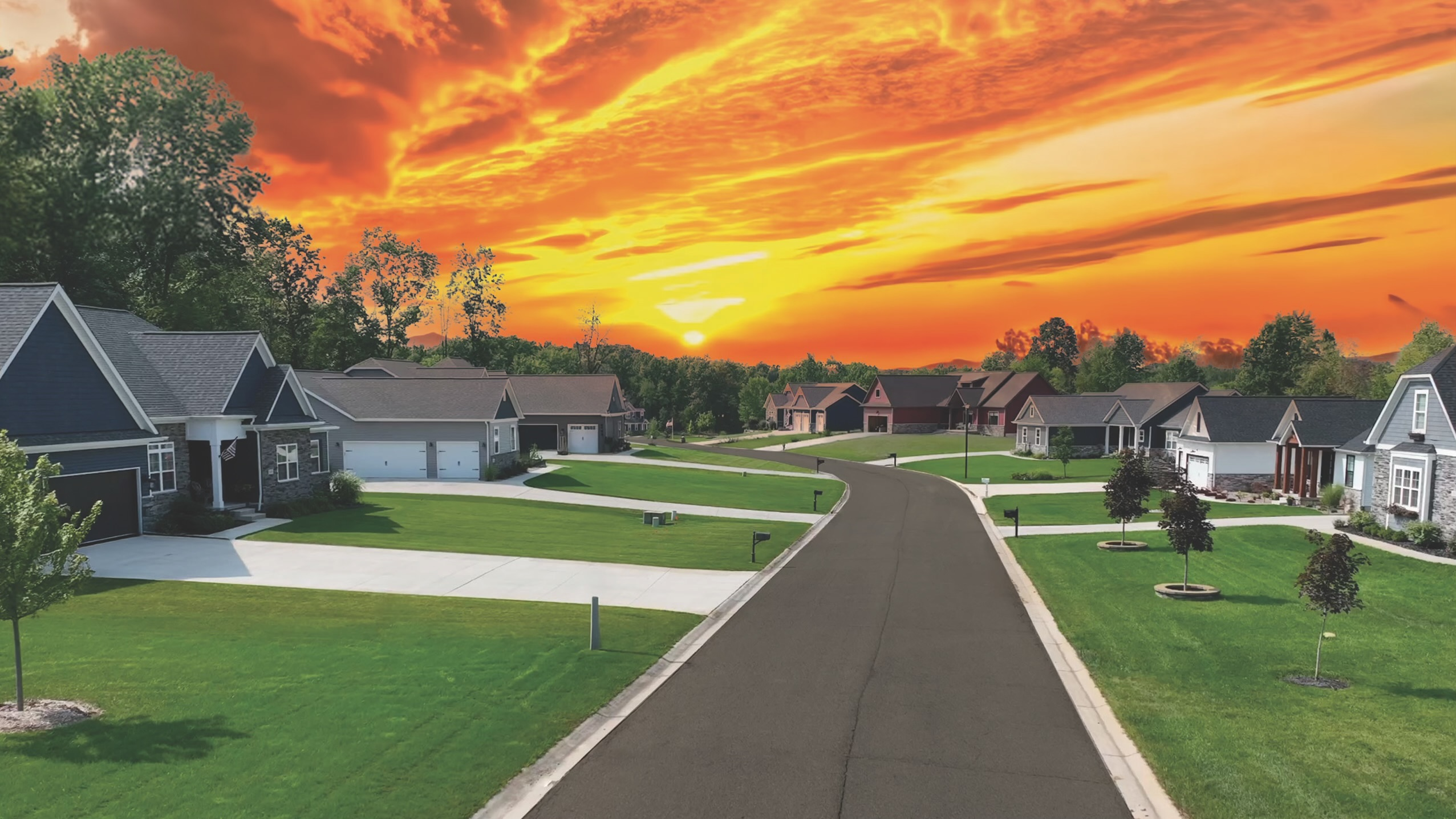
You've decided to build a new construction home — that's the easy part. The harder decision is choosing which homesite in the community you actually want to live on. In a neighborhood like Oaks of Tyrone, where every lot is a wooded one acre, each homesite has its own personality: different tree coverage, different positioning relative to neighbors, different views, different sun exposure, and different tradeoffs that aren't obvious until someone points them out.
The homesite you pick determines how much natural light your kitchen gets, how much privacy you have from your nearest neighbor, whether your backyard faces woods or a cul-de-sac, and how the house sits on the land for the next twenty or thirty years. Choosing well is worth the effort — and most of the factors that matter aren't the ones buyers instinctively focus on.
Why homesite selection matters more in custom communities
In a production-built subdivision where lots are quarter-acre rectangles cleared to bare dirt, homesite selection is mostly about location within the neighborhood — which street, how close to the entrance, proximity to amenities. The lots themselves are interchangeable because they've been stripped of the features that would differentiate them.
In a community like Oaks of Tyrone, where Big Sky Development preserved the mature tree canopy as part of the community design, every homesite is distinct. The trees that surround your property line, the way the terrain slopes, and the angle of the sun through the canopy all vary from lot to lot. That's a good thing — it means you're choosing between genuinely different settings, not identical pads on a grid. But it also means the choice deserves more thought than most buyers give it.
Orientation and sun exposure — where does the light actually fall?
Solar orientation is one of the most consequential factors in homesite selection, and one of the most frequently overlooked. In Michigan's climate, a south-facing backyard gets significantly more natural light during the winter months than a north-facing one. For buyers who want a bright great room, a warm patio, or a yard that thaws early in the spring, orientation matters.
When evaluating a homesite, ask the builder or agent to show you a site plan with the home's proposed footprint and the compass orientation marked. Better yet, walk the lot at different times of day if possible. Morning light enters from the east, afternoon light from the west, and the sun's path through the sky is lower in winter — meaning northern exposure gets almost no direct sunlight from November through February.
On wooded lots specifically, the tree canopy modulates sun exposure significantly. A south-facing lot with dense mature oaks will get filtered light that's comfortable in summer but still allows winter sun through after leaf drop. A north-facing lot with the same tree cover can feel dark year-round. It's a difference you'll notice every day in the home once you move in, but it's hard to evaluate from a printed site plan alone.
Privacy and neighbor spacing — the distance that matters
One-acre lots provide substantially more privacy than the quarter-acre or smaller lots common in Michigan subdivisions — but privacy on an acre lot isn't automatic. It depends on the relationship between your homesite, your neighbor's homesite, and the trees between them.
Consider these questions when evaluating privacy on a specific homesite:
- What's between your home and the nearest neighbor? A row of mature oaks or pines along the property line provides visual screening year-round (evergreens) or seasonal screening (deciduous). A homesite with a natural tree buffer is fundamentally more private than one where the property lines are open.
- How is the homesite angled relative to the neighbor? Two homes can be the same distance apart but feel very different depending on whether the windows face each other, face away, or face at an angle. A homesite where the primary living spaces face the woods — rather than the neighbor's great room — will feel more private every day.
- Where will the driveway and garage be positioned? A side-load garage or a driveway that approaches from a different angle can keep foot traffic and headlights away from your primary outdoor living space.
- Is the lot on a curve or corner? Interior lots on a gentle curve can feel more private than straight-street lots because the geometry of the road creates natural distance and angle variations between homes.
At Oaks of Tyrone, the one-acre lot size combined with the preserved tree canopy means that most homesites have genuine visual privacy from the neighbors — not the "you can technically see their living room if you stand in exactly the right spot" kind of privacy that marketing photos suggest, but actual screening from mature trees and consistent setback distances.
Drainage and elevation — where does water go?
On wooded, rolling terrain — the kind of land you find in Tyrone Township and much of Livingston County — drainage is a practical concern that directly affects the livability of your homesite. Water that drains toward your home, pools in your backyard, or flows across your driveway after heavy rain isn't just annoying; it can cause long-term foundation and landscaping issues.
Ask the builder about the drainage plan for each homesite you're considering. A good builder like Big Sky Development will have completed a topographic survey and designed the grading for each lot to direct water away from the building pad. But the natural topography still matters — a homesite that sits naturally higher on the terrain will always drain better than one in a low-lying area, regardless of how well the grading is engineered.
Look for standing water, saturated soil, or areas where leaves collect and decompose when you walk the lot. These are telltale signs of poor natural drainage. A lot that drains well on its own requires less engineered intervention and is more resilient during heavy rain events.
The tree canopy — which trees stay and what the woods look like after building
In a community that emphasizes tree preservation, the relationship between the trees and the homesite is the single biggest factor in how the property looks and feels after construction. This is worth asking about directly: which specific trees on the homesite will be preserved, and which will be removed for the building envelope?
At Oaks of Tyrone, Big Sky Development designs each homesite to preserve the maximum number of mature trees within and around the building footprint. The home is positioned to work with the existing canopy, not against it. But every custom build requires removing some trees — for the foundation, the driveway, utility access, and the immediate yard area. The question isn't whether some trees come down; it's how many, which ones, and what the remaining canopy looks like.
When you walk a homesite with the builder or site agent, ask them to walk you through the building envelope: where the home sits, where the driveway goes, and which trees fall inside each zone. Then step back to the property corners and look at what remains. The preserved trees are what make the homesite valuable — they're not just decoration, they're the reason you chose a wooded acre in the first place.
Views and outlook — what you'll see from every room
Most buyers evaluate a homesite from the street. That's the least useful vantage point. The view from your primary bedroom window, your kitchen sink, and your back patio matters infinitely more than the view from the driveway.
Ask the builder to show you where the primary living spaces will face on each homesite you're considering. On wooded lots, the "view" is typically the tree canopy and the privacy it provides — and that's a feature, not a limitation. But the direction and depth of the woods vary from lot to lot. Some homesites back up to deep, continuous woodland. Others have a tree line that gives way to a neighboring property or open land. The depth of the wooded view from your back windows is worth understanding before you commit.
For homesites that back to preserved common areas or larger tracts of woodland, the view is effectively permanent — no future neighbor will build behind you and change the character of what you see. That's a premium worth paying for, and it's one of the less-discussed advantages of buying into a well-planned community rather than assembling lots independently.
Road position and lot placement
Where a homesite sits on the street affects noise, traffic, and the overall feel of the property. Here's a quick breakdown of what to consider:
- Cul-de-sac lots — typically the most private, with the lowest traffic volume and no through-traffic, making them some of the most sought-after lots in any community.
- Interior lots — steady but low neighborhood traffic. The most common and typically the most balanced option for privacy and convenience.
- Corner lots — more road frontage and often a larger apparent yard, but more traffic exposure on two sides and less privacy from the street. Can be excellent if the lot has strong tree screening along both road-facing sides.
- Crescent or curve lots — the natural curve of the road can create additional setback distance and angular privacy that straight-street lots don't offer.
Future development — what could change around you?
A homesite that looks perfect today can feel very different in five years if the adjacent land is developed into a dense subdivision, a commercial property, or a busy road. Before committing to a homesite, it's worth understanding what's planned or possible on the surrounding parcels.
In established communities like Oaks of Tyrone in Tyrone Township, the surrounding area is primarily residential and agricultural, with large-lot zoning that limits density. But the specifics vary by lot position. Ask about what's adjacent to the community on each side — and whether any of those parcels have development potential that could change the character of the area.
This is one area where local expertise makes a real difference. Rob Moen, as both a long-time local agent and the Marketing Director for Big Sky Development, can walk you through what surrounds each homesite at Oaks of Tyrone and what the long-term outlook is for the surrounding area — the kind of context that a site plan or listing photo alone can't provide.
The walk-through: how to evaluate a homesite in person
Online site plans and photos are a starting point, but the only way to truly evaluate a homesite is to walk it. Here's a practical checklist for your visit:
- Visit at different times of day — morning and afternoon light tell very different stories on wooded lots. If you can only visit once, try for midday.
- Stand where the great room will be — ask the builder to mark or describe the home's footprint, then stand in the approximate location of your primary living space. What do you see? How does the light feel?
- Walk to the back of the lot — the rear property line is where your backyard ends and the woods (or neighbor's property) begins. Understand what's back there and how it affects your privacy.
- Check for standing water or soft ground — even a quick rain can reveal drainage patterns. If the lot has had recent rain and you see puddles or saturated soil in the building area, ask about the drainage plan.
- Listen — stand quietly for a minute. What do you hear? Birdsong and wind in the trees are the sounds you're buying. Highway noise, commercial activity, or neighbor proximity are the sounds you want to screen out.
- Identify the mature trees you want preserved — if there's a particular oak or maple that you love, ask whether it falls inside or outside the building envelope. In many cases, the builder can adjust the home's position slightly to save a key tree.
- Ask about utility connections — where do water, electric, gas, and internet enter the lot? The utility access point affects where the driveway can go and how the landscape will be graded.
Frequently asked questions
How do I know which homesite is best for me?
The best homesite depends on your priorities — privacy, sun exposure, views, road position, and proximity to the community entrance. Walk each lot you're considering, ideally at different times of day, and discuss your priorities with the builder or agent. A good agent will match your lifestyle preferences to the specific characteristics of each homesite.
Can I choose where the home sits on the lot?
Yes. In a custom build community like Oaks of Tyrone, the home's position on the lot is designed in collaboration with the builder. Big Sky Development adjusts the building pad, driveway orientation, and home positioning to work with the lot's terrain, trees, and drainage — and to align with your priorities for views, privacy, and sun exposure.
Does homesite selection affect the price?
In some communities, premium lots — corner lots, lots with deeper wooded views, or cul-de-sac positions — carry a premium. At Oaks of Tyrone, the one-acre wooded homesites are priced as part of the home package, so the lot selection process is about choosing the setting that fits you best rather than navigating tiered lot pricing.
What if I want to save specific trees on my lot?
Talk to the builder early in the design process. Big Sky Development works with buyers to identify trees they want preserved and adjusts the building envelope where possible to accommodate them. The earlier you flag a priority tree, the more flexibility the design team has to save it.
Should I get a survey before choosing a homesite?
The builder will complete a detailed topographic survey and site plan for your specific homesite as part of the pre-construction process. However, walking the lot with a knowledgeable agent or builder before committing gives you a practical sense of the terrain, trees, and setting that a survey alone can't convey.
What's the most common mistake buyers make when choosing a homesite?
Evaluating the lot from the street and never walking to the back of the property. The street view tells you about access and curb appeal. The back of the lot tells you about your actual daily living experience — the view from the patio, the privacy from neighbors, and the depth of the woods. Always walk the full property before deciding.
Ready to find your homesite?
Rob Moen will walk you through every available homesite at Oaks of Tyrone, help you evaluate the options based on your priorities, and answer any questions about the community, the builder, or the process. Contact him directly to schedule a private tour.