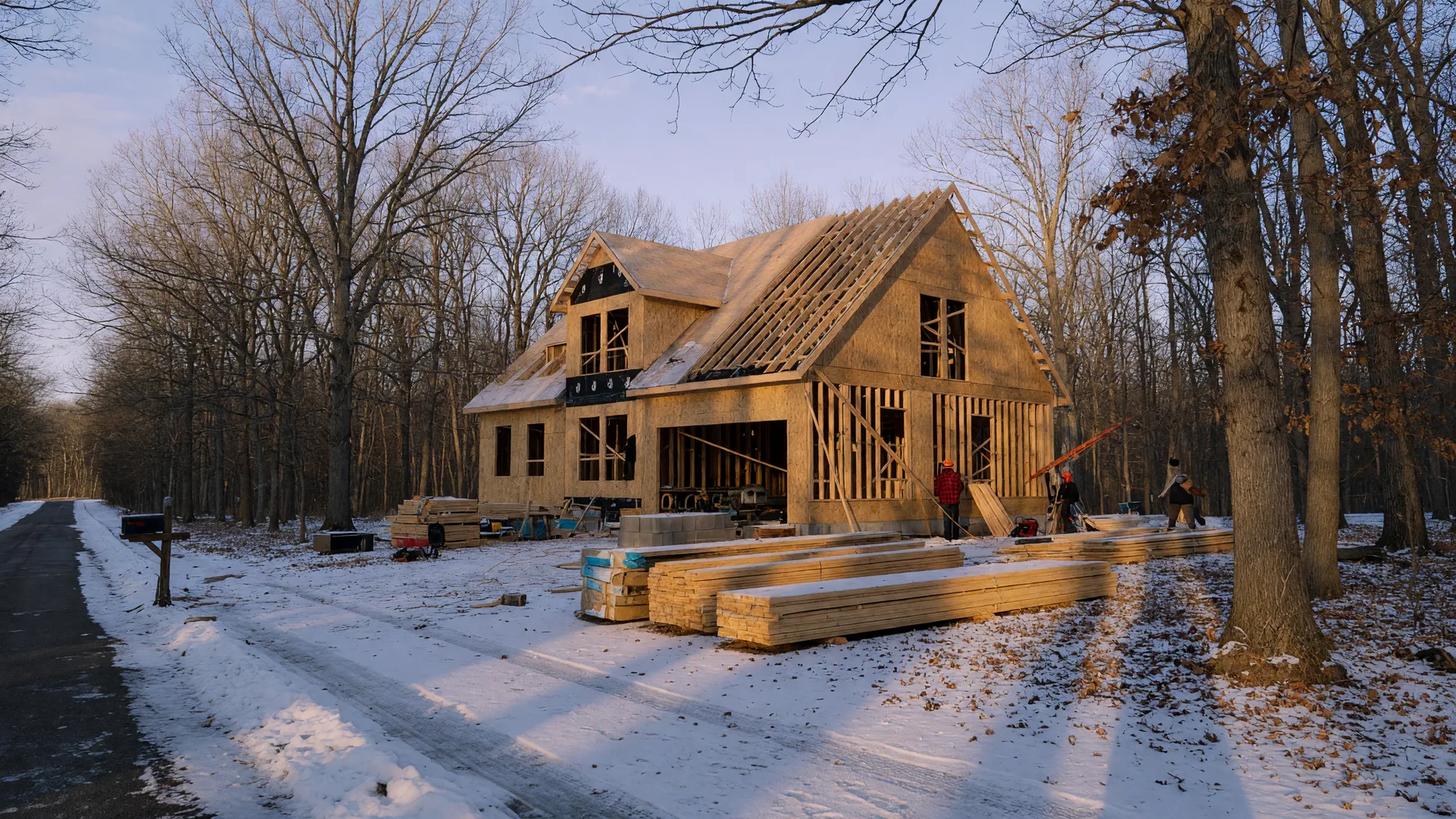
Can you build a custom home in Michigan in the winter? Yes, you can, and builders across the state do it every year. Foundations get poured, homes get framed and dried in, and interior work continues right through November, December, January, and beyond, as long as cold-weather construction rules are followed and the builder has the equipment, crews, and experience to manage it. The question that matters for a buyer near Fenton or Tyrone Township is not whether winter building is possible. It is how a seasoned, year-round builder handles the cold.
If you are weighing a fall or winter start at a community like Oaks of Tyrone in Tyrone Township, here is what actually happens to a custom home build in a Michigan winter, why it works, and what to ask a builder before you commit to it.
The short answer: yes, with the right builder
Winter is not a hard stop for residential construction in Michigan. A common rule of thumb among builders in the state is to get the foundation in the ground before the ground freezes, usually by mid-November. After that point, experienced crews shift to cold-weather methods: heated, field-constructed tents for concrete work when temperatures drop, heated shells for framing and drywall, and close attention to what the thermometer is doing on every pour day.
What winter does change is the pace and the process. A build that starts in the fall or winter often spends more of its early months on site prep, foundation, and getting the house dried in before the deep cold arrives, then moves inside for mechanicals and finishes. That is exactly the rhythm a good builder plans around. If you are curious how a fall start maps out month by month, our guide to breaking ground in the fall walks through the whole timeline.
Foundations in a Michigan winter: what actually happens
Concrete is the piece most buyers worry about, and rightly so. Michigan's frost line runs roughly 42 to 60 inches deep, which is why foundations here are dug deep and poured to withstand the freeze-thaw cycle. Cold-weather concreting follows the ACI 306 standard used by the Michigan Concrete Association: cold weather begins when air temperature drops below 40 degrees Fahrenheit, concrete must be placed and maintained at a minimum of 55 degrees Fahrenheit, and it must be cured under protection for about seven days. It is never poured on frozen subgrade.
How do builders keep concrete warm enough? They use heated, field-constructed tents around the pour area, insulated blankets, and portable heaters, and they watch the forecast like a weather desk. When temperatures fall below roughly 20 degrees Fahrenheit, many builders postpone a pour rather than risk it. The result is that foundations do get poured in November and even December, just on days when the conditions cooperate. For the full range of foundation choices on a wooded lot, our guide to foundation options for a Michigan custom home covers the tradeoffs.
Framing, sheathing, and getting the house dried in
Framing in cold weather is very doable, and winter has one quiet advantage: low humidity lets kiln-dried lumber shed moisture, which can actually reduce warping and shrinkage later. Crews frame the walls, set the roof, and sheath the structure, then the home gets dried in with windows, doors, and roofing so the interior is protected from the elements.
Once the shell is sealed, the build moves indoors. Mechanicals, insulation, drywall, trim, cabinetry, and finishes all progress through the winter inside a heated home, which is the same work that happens in July. That is why a winter start does not mean a stalled build. It usually means steady interior progress while the snow piles up outside. Crews simply do not frame over ice, and frozen plywood stays on the truck until it thaws.
What a winter build looks like on a wooded one-acre lot
A wooded homesite adds a few specific considerations to a winter build, and it is worth understanding them before you pick a lot. At Oaks of Tyrone, every homesite is a full wooded acre, and Big Sky Development uses a tree preservation approach: the building pad, driveway, and utility paths are cleared, and the mature oaks and maples stay. On a wooded lot, site prep is easier to schedule before the ground freezes, which is one reason fall starts are popular here.
Winter also affects the supporting pieces. Well and septic work, if your site needs them, are typically planned around soil conditions and frost, and utility and driveway work can be staged for milder windows. A lot-included community simplifies all of this because the builder coordinates the land work as part of the build rather than handing the buyer a raw parcel and a to-do list. For a closer look at how utilities work on rural acreage, our guide to septic, tree preservation, and wooded-lot building is a good starting point.
Why an established, year-round builder matters
Winter is where builder experience shows up. A company that has been building through Michigan winters for decades has the tents, heaters, blankets, and crews, and has already learned the lessons about frozen ground and below-freezing pour days. A newer operation may stop work entirely or push a schedule with no buffer for weather.
Big Sky Development is a good example of the year-round model. The company has been building custom homes throughout Southeast Michigan since 1994, more than 30 years of continuous construction through two recessions and a pandemic without ever pausing operations. Big Sky works with in-house teams, the owner personally visits active jobsites to oversee quality, and every home is backed by a 10-year in-house structural warranty, nine times longer than Michigan's state requirement, and built with more than 96% American-made materials and labor. You can read more on the About Big Sky Development page.
The practical upsides of starting in the fall or winter
Starting a build as the weather turns is not just possible. For many buyers it is genuinely smart. A fall or winter start means more calendar time for design and selections before construction begins, and it often lands in a less crowded part of the builder's schedule. Locking in a contract before the spring rush can also protect your price and your place in the build queue.
The timing also shapes move-in. A build that starts in the fall typically finishes in the warmer months of the following year, which means landscaping, a driveway, and outdoor living spaces get a full season to settle in around the new house. For a full look at how seasonal timing changes the build, see our guide to the best time of year to break ground.
Questions to ask before you commit to a winter build
If you are planning to break ground in the fall or winter, put these questions to the builder before you sign:
- How many Michigan winters have your crews actually built through, and does your team keep working or shut down?
- What is your cold-weather concrete process, and when do you postpone a pour?
- How do you keep a home under construction heated through framing and drywall season?
- What buffer is built into the schedule for weather, and how are delays communicated?
- Can I visit the jobsite during construction, including in winter?
- Is your warranty in-house, and does it cover work done in cold conditions the same way?
A builder who answers these directly, with specifics, is a builder you can trust with a winter build. The general custom home building timeline in Michigan runs about 8 to 12 months from contract to move-in, and a good builder will show you how a winter start fits into that window.
Frequently asked questions
Can you pour a foundation in Michigan in the winter?
Yes. Cold-weather concreting follows ACI 306 rules: concrete is placed and maintained at a minimum of 55 degrees Fahrenheit, cured under protection for about seven days, and never poured on frozen subgrade. Builders use heated tents, blankets, and heaters, and postpone pours in extreme cold.
How cold is too cold to build in Michigan?
Cold-weather concreting rules kick in below 40 degrees Fahrenheit, and many builders postpone concrete pours below roughly 20 degrees. Framing and interior work continue at much lower temperatures, with the home kept heated once it is dried in.
Does building a custom home in winter cost more?
Winter work can add heating and protection costs in some cases, but a fall or winter start can also lock in pricing and scheduling before the spring rush. Experienced builders like Big Sky Development plan around the weather, so buyers see a firm, realistic price up front.
Do Michigan custom home builders really work through the winter?
Yes, established year-round builders do. Big Sky Development has built continuously since 1994, through two recessions and a pandemic, without pausing operations. Winter builds shift to cold-weather methods and interior work rather than stopping.
When should I break ground if I want to build through the winter?
Most builders aim to get the foundation in before the ground freezes, usually by mid-November. Starting in the late summer or fall gives you time for design and selections, then a foundation pour before the deep cold, with interior work carrying through winter.
Which school district serves Oaks of Tyrone?
Oaks of Tyrone is in the Hartland Consolidated Schools district. The community carries a Fenton, Michigan mailing address. Visit hartland.k12.mi.us for enrollment and academic information.
Plan a fall or winter start at Oaks of Tyrone
The best way to understand how a winter build works is to see the land and talk it through with the team that has been building through Michigan winters for over 30 years. Schedule a private tour of Oaks of Tyrone to walk the wooded one-acre homesites, review the custom floor plans, and ask your timeline questions directly.